 Made in Sri Lanka


How Coir Geotextiles Fight Erosion — and Then Disappear
By Macgrow Lanka Team · · 2 min read
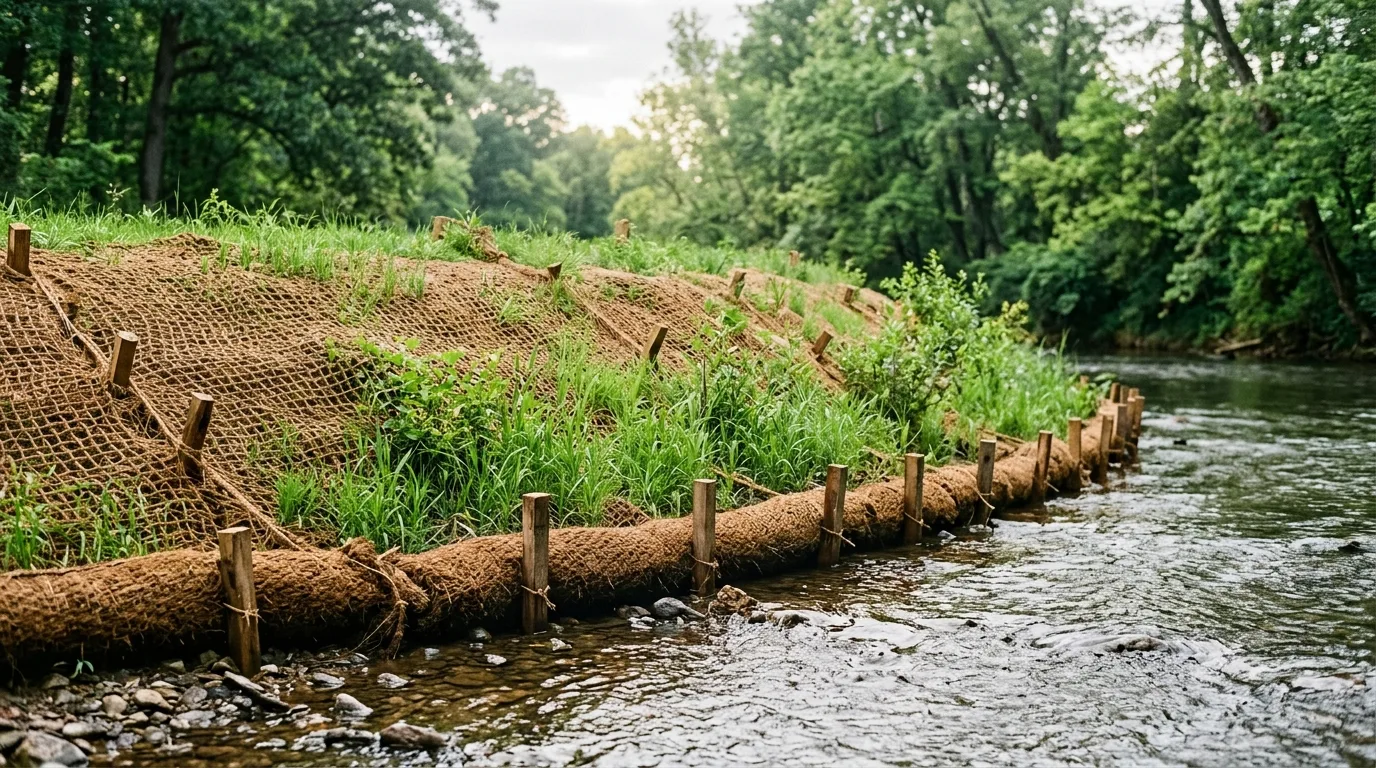
Bare soil is defenceless. A single heavy monsoon downpour can strip millimetres of topsoil from an unprotected slope; a swollen stream can eat a metre of bank in a season. The traditional answers — concrete, rock gabions, plastic geogrids — stop the erosion but leave the land armoured and lifeless, often forever.
Soil bioengineering takes a different bet: protect the soil temporarily, with something strong enough to hold through the danger years, while living vegetation grows into the permanent solution. And the material that makes this possible, on projects from Sri Lankan riverbanks to European motorway cuttings, is coconut coir.
Why coir, specifically?
Three properties make coir the reference natural fiber for erosion control:
Strength. Coir is the strongest of all natural fibers, with high lignin content that jute and straw cannot match. Woven into netting, it armours soil against raindrop impact and sheet flow from day one.
Longevity — but not too much. Jute blankets decay within a year or two, often before vegetation is ready. Synthetics persist for decades after they are needed. Coir sits in the sweet spot: three to six years of field life, matching almost exactly the establishment window of grasses, shrubs, and riparian species.
Water behaviour. Coir absorbs moisture and releases it slowly, creating a humid microclimate at the soil surface that dramatically improves seed germination on harsh, exposed slopes.
The toolkit
A typical bioengineered slope or bank uses three coir products in concert:
- Coir geotextile nets (400–900 gsm woven mesh) blanket the graded, seeded slope. Vegetation grows up through the apertures while the net holds soil and moisture. Heavier grades take steeper slopes and faster flows.
- Coir logs — dense fiber-packed cylinders staked along the bank toe or on contour — absorb wave and current energy where it concentrates, trap sediment, and give planted stock a moist, protected foothold.
- Coir rope mats armour the points of concentrated wear: channel inverts, crossings, path surfaces — anywhere an open mesh would be overwhelmed.
The part engineers love
By year five, a well-designed installation has effectively deleted itself. Roots have taken over the structural work, the coir has decomposed into humus that feeds the new vegetation, and there is nothing to remove, maintain, or apologise for. Compare the whole-life cost — and the ecology — with a concrete revetment, and the argument makes itself.
Wildlife agencies add one more point: unlike plastic mesh, degraded coir cannot entangle birds, reptiles, or fish, and it never fragments into microplastics.
Specifying it right
The failures we see almost always trace to under-specification — 400 gsm net on a slope that needed 900, logs without proper toe trenching, no anchor trench at the crest. If you are designing an installation, send us the slope angle, soil type, flow or rainfall data, and establishment species. Matching the grade to the site is most of the engineering, and we are glad to help with it.
Planning an erosion-control or restoration project? Talk to us about grades, quantities, and container scheduling.